
Brass compression outlet adapters are crucial for keeping trustworthy plumbing connections. The fittings attach outside-diameter (OD) tubing to threaded ports, guaranteeing leak-resistant joints. This is key for equipment including refrigerators and ice makers. Using brass is popular due to its strength and easy fitting process.
Shop For 1 2 Male To 3 8 Female Adapter
This article discusses the compression outlet adapter for use with 3/8 and 1/2 OD tubing. Installers and DIYers frequently seek these adapters for multiple plumbing needs. These parts come in configurations including straight adapters, male and female threaded outlets, unions, and reducing adapters.
For installers, having access to wholesale options is key. Installation Parts Supply (IPS) stocks a wide range of brass adapter fittings. They cater to individual and volume purchases, providing cost-effective rates. The following sections will discuss compliance with drinking water regulations and California Proposition 65. We will also offer technical tips on installing and leak prevention.
Essential Summary
- Compression outlet brass adapter joins OD tubing to pipe threads for water feeds.
- The brass fitting is the top choice for fridges, ice machines, and filtration.
- 3/8 water line adapter is a standard size for hooking up appliances.
- The supplier offers wholesale options from one unit to bulk lots.
- Later sections cover compliance, installation best practices, and troubleshooting.
Reasons To Select Brass Compression Fittings For Plumbing Jobs
Compression fittings made of brass are the go-to option for contractors and residents. They deliver durable service and secure sealing. This makes them suitable for supply lines and output points. Brass compression fittings guarantee uniform construction and exact specs, supporting durable joints.
Brass Durability And Resistance To Corrosion
The brass material withstands rust and functions effectively in humid settings. This characteristic ensures the ferrule sits right and keeps threads from seizing. A brass compression nut keeps tightness long-term without splitting, guaranteeing watertight joints under normal conditions.
Matching Common Materials: Copper, PVC, And PEX
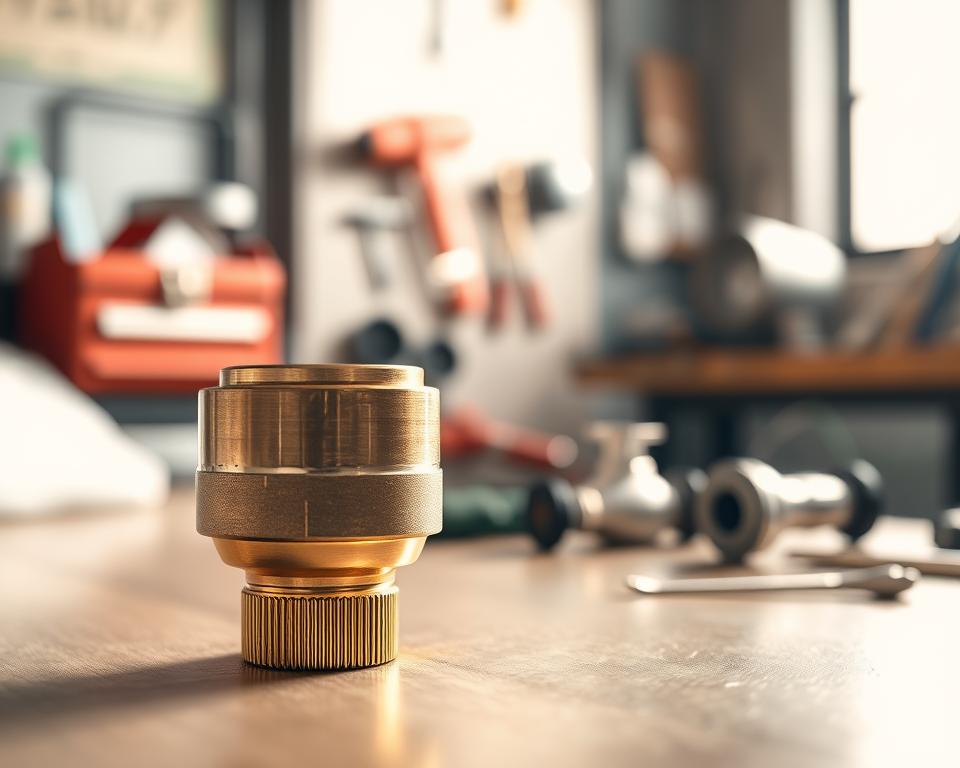
These brass fittings smoothly join with copper pipes and work well with plastic lines using the right inserts or sleeves. Lots of makers provide conversion parts for joining PEX, PVC, or copper without damaging the pipe. It is crucial to use the correct insert or sleeve to prevent crushing soft plastic lines.
Superiority Over Plastic And Steel In Supply Line Use
The material offers more robust threading and better heat and pressure ratings versus plastic parts. Compared to steel, brass is less prone to corrosion in drinking water setups and lowers electrolysis risks with copper. For jobs such as connecting a fridge or ice maker, a 3/8 to 1/2 converter made of brass simplifies installation and provides a strong link.
Understanding Compression Outlet Brass Adapters
The compression outlet brass adapter connects tubing to threaded or alternate exits. It is a compact brass part that simplifies transitions from compression tubing to NPT threads or valves. It’s ideal for fridge and ice machine connections, reverse osmosis outlets, and humidifier feeds. It guarantees a secure 3/8 comp to 1/2 thread or similar connection.
What It Is And Where To Use It
A compression outlet adapter utilizes a compression nut and ferrule for a secure seal. It offers an outlet type such as female or male threads. Plumbers choose it to bypass welding or flaring when joining 3/8″ or 1/2″ OD supply tubing.
It’s commonly used to link 3/8″ OD water supply lines to refrigerator water valves. It also serves for connecting RO units to home plumbing and attaching humidifiers to cold water pipes. Brass is preferred for its durability, corrosion resistance, and predictable torque behavior when tightening the compression nut.
Typical Layouts: Compression In And Adapter Out
Common designs pair a compression entry with a threaded outlet. For instance, 3/8″ OD comp to 1/4″ FIPS for small appliance inlets, and 3/8″ OD comp to 3/4″ MIPS for larger valves. Reducing union adapters let you switch between tubing sizes or alternate thread types without specialty tooling.
Installers also find versions labeled as 3/8 comp to 1/2 thread outputs for supply line conversions. The 3/8 by 1/2 size is frequent on fixtures where the tube is thinner than the device input.
Typical Specifications And Supplier Listings
Online lists list compact parts with exact details. Common listings include 3/8″ OD comp x 1/4″ FIPS and 3/8″ OD x 3/4″ MIPS. A standard small adapter measures roughly 30 x 18 x 15 mm and weighs near 0.04 kg, useful for cramped sink areas.
Keywords such as Compression Outlet Brass Adapter, compression outlet adapter, 3/8 to 1/2 adapter plumbing, or 3/8 by 1/2 adapter will find the right items. Selecting the correct part minimizes swapping parts and accelerates fixing when working with mixed tubing and thread types.
Understanding Sizes: 3/8 To 1/2 And 1/2 To 3/8 Brass Adapters
Choosing the right adapter requires matching the tube OD to the fitting’s thread. Compression sizes depend on the tubing’s OD. As an example, a 3/8″ OD tube needs a matching nut and ring. Threaded connections adhere to norms like NPT, MIPS, or FIPS, with distinct labels. Make sure the comp end matches the tubing’s OD, and the threaded side aligns with the pipe or appliance.
OD versus thread size explained
Compression fittings are measured by the tubing’s outside diameter. A 3/8 comp fitting works on 3/8 OD lines. Pipe threads, though, are nominal and are usually bigger than the hole size. For example, a 1/2 inch thread does not match a 1/2 inch tube OD. Always check both labels before buying.
Deciphering common part labels
Suppliers mark parts well, like a 3/8 x 1/2 adapter for a 3/8″ OD compression end and a 1/2″ threaded end. You will see items such as 1/2 inch female to 3/8 male adapter or supply line adapters. Many catalogs show both sizes, like 3/8″ OD Comp x 1/4″ FIPS, to avoid confusion.
Choosing the right adapter type
Use a 3/8 to 1/2 male adapter for a compression connection on 3/8″ tubing to a 1/2 male thread. Choose a 1/2 female to 3/8 male adapter to connect a 1/2″ female thread to a 3/8 male side. Selecting the wrong orientation can cause leaks or require more parts.
| Label | Comp End | Pipe End | Typical Use |
|---|---|---|---|
| 3/8 x 1/2 adapter | 3/8 inch tube | 1/2″ pipe thread (male or female as specified) | Supply lines to appliances with 1/2″ ports |
| 1/2 inch female to 3/8 male adapter | 3/8″ male compression or pipe | 1/2″ female pipe thread | Mating existing 1/2″ female port to 3/8″ feed |
| 3/8 to 1/2 supply line adapter | 3/8″ OD compression | 1/2″ threaded connection | RO or fridge line changes |
Suppliers provide a wide range, from 1/8″ to 3/4″ OD. Ensure the part label fits your tube size and thread type for the device. If unsure, measure the OD and check the thread type before ordering. For water service taps, check if you require a 1/2 to 3/8 water line adapter or a 3/8 to 1/2 threaded adapter to prevent re-doing work.
Adapter Roles: Connecting Supply Lines And Outlets
Compression outlet brass adapters convert tubing to threaded inlets and shutoffs. They allow a 3/8 adapter to join appliance ports, service valves, or tees. This is frequent for supplying ice machines, refrigerators, reverse osmosis systems, and humidifiers.
For fridges and ice makers, standard tubing is 3/8″ OD. A 3/8 to 1/2 supply line adapter or a 1/2 to 3/8 supply line adapter bridges tubing and appliance threads. Plumbers use these fittings to join compression tubing to machine inputs or add a valve using a brass valve.
RO systems and humidification units use small tubes. Many setups use a 3/8 OD comp x 1/4 FIPS fitting to supply a line or connect a valve. This method also supports fast connections for pet fountains, swamp coolers, and patio misters.
Saddle valves and piercing valves offer easy tapping. A piercing kit attaches to 3/8″ through 3/4″ inlet piping and delivers a 1/4″ compression outlet. Kits usually have inserts or sleeves to shield the tube and ensure a leak-free seal when connected.
Below is a quick comparison to help choose the correct part for standard jobs.
| Use Case | Typical Adapter | Details |
|---|---|---|
| Fridge or Ice Machine | 3/8 adapter for inlet | For 3/8 inputs or thread changes |
| Line Size Change | 3/8-1/2 or 1/2-3/8 adapter | Connects tubing to valves |
| Reverse osmosis branch | 3/8 OD comp x 1/4 FIPS adapter | Feeds RO post-filter or accessory fittings without soldering |
| Accessory tap | Piercing valve 1/4 out | Quick fit; protect plastic tube |
| Shutoff control | Brass compression valve | Reliable shutoff for adapters |
Understanding The Parts Of A Brass Compression Fitting
This section details the parts involved in working with compression fittings. Knowing each part is vital for choosing the right connector or fitting for different jobs.
The basic setup includes three main parts: the nut, the sleeve or ferrule, and the body. The nut tightens the ferrule against the fitting. The ferrule, when tightened, seals the tube with a metal-to-metal connection.
The design of the ferrule is important. A single-piece brass ferrule is ideal for copper lines. For PEX or plastic, a plastic sleeve or insert is required to prevent damage and ensure sealing. Vendors sell these parts in many sizes, including 1/4″, 3/8″, and 1/2″ OD.
Every component does a specific job. A connector connects two lengths of tubing with the same OD. A brass compression coupling joins two sections end-to-end. An outlet adapter changes a compression connection to a threaded outlet for fixtures or appliances. A female to female water line adapter joins two male parts without changing tube.
Wholesalers provide nuts and ferrules in sizes from 1/8 to 3/4, with pricing per piece. Note that that the compression nut doesn’t touch water. Instead, the ferrule and body create the primary fluid path. This detail is significant when choosing parts for drinking water.
- When to choose brass ferrules: use for copper for long-lasting seals.
- Using plastic sleeves/inserts: select for plastic to prevent leaks.
- Choosing adapters: pick a compression outlet adapter for appliance feeds, a coupling for inline joins, and a connector for straight joins.
Proper Installation Of Brass Compression Fittings
Good installation starts with straight cuts and correct parts. A good cutter is needed to avoid oval ends. It is crucial to remove burrs from inside and outside the tube so the ferrule sits flat. Ensure the outside diameter of the pipe matches the fitting. Plastic tubing often requires a sleeve or insert to seal right.
- Cut tubing square; use a guide.
- Remove burrs to prevent leaks and ferrule misalignment.
- Check diameter against the ferrule specification before starting.
- For PEX or soft plastics, add the recommended sleeve or insert.
Tightening recommendations:
- Start threaded connections by hand to avoid cross-threading.
- Bring the compression nut until hand tight.
- Use a wrench to complete compression nut tightening, usually a quarter to half turn more as advised.
- Don’t over-tighten; excess torque can deform the ferrule and cause dripping.
Thread sealant guidance:
- Do not use thread sealants on the compression threads. The ring seals it and sealants can prevent proper seating.
- Use PTFE on threaded parts on pipe-threaded portions such as NPT or IPS fittings.
- For mixed connections like comp-to-NPT, leave the compression side clean and seal the NPT threads with PTFE tape or approved joint compound.
- Manufacturers may recommend specific compounds such as thicker PTFE tape or pipe joint compound for high-pressure pipe threads; follow their guidance.
| Step | Task | Reason |
|---|---|---|
| 1 | Cut and deburr | Prevents ferrule misalignment and leak paths |
| 2 | Check OD and parts | Ensures good fit |
| 3 | Hand tighten first | Reduces risk of cross-threading and initial alignment |
| 4 | Wrench-tighten compression nut 1/4–1/2 turn | Completes the seal without deforming the ferrule |
| 5 | No sealant on compression | Preserves ferrule sealing action; use PTFE for NPT threads |
Potable Water Safety And Lead Compliance Guide
Choosing the right adapter is a delicate balance between safety, compliance, and application. We will discuss laws and codes, warnings, and how to pick parts for drinking water versus industrial use.
US Standards For Lead Content
The SDWA mandates limits on lead content that come into contact with drinking water. Current rules and NSF codes require low lead. Look for lead-free parts that meet NSF 61/9 or state rules such as AB 1953.
California Proposition 65 Warnings And Handling
California Proposition 65 requires warnings for products that expose users to harmful chemicals. Vendors such as PlumbingSupply.com and major distributors post California Proposition 65 notices on brass items with detectable lead. Always wash hands after handling non-certified parts and don’t use them for drinking water.
Picking Parts For Water Or Industry
For potable water, choose a certified potable water compression fitting. These items are labeled as lead free brass fittings and have NSF marks or state approvals. For machines, watering systems, or non-potable use, brass fittings not for potable water are fine if clearly marked for industrial service.
Safe Practices And Distributor Labeling
Always check product labels and data sheets before buying. Sellers usually say if an item is “not for potable water” or provide NSF certifications. Use certified parts where required with the Safe Drinking Water Act and codes.
Practical Checklist
- Check for NSF 61 or equivalent certification for drinking water use.
- Check tags for lead free brass fittings and any California Proposition 65 warnings.
- Do not use brass fittings not for potable water on household supply lines.
- If unsure, choose a potable water compression fitting from a top brand such as Mueller, Watts, or Nibco.
Standard Brass Adapter Specs And Examples
Wholesalers and plumbing suppliers sell a variety of brass compression parts for service and repair. They carry small ferrules and nuts, as well as full adapters and elbows. This simplifies finding the right sizes by part name.
Available stock sizes
Sellers keep fitting sizes ranging 1/8 to 3/4. They offer increments like 1/8″, 3/16″, 1/4″, 5/16″, 3/8″, 7/16″, 1/2″, 5/8″, 3/4″, and 7/8″. These match common supply lines in homes and machines.
Sample product specs
Catalog entries list tubing OD x thread type. For instance, you might see 3/8″ OD x 1/4″ FIPS or 3/8″ OD x 3/4″ MIPS. There are also 3/8 male pipe x 9/16 female adapters and reducing unions for converting compression to adapter exits.
Part examples and cross-references
Parts such as 3/8 by 1/2 are popular for size transitions. The 3/8 to 1/2 water supply line adapter is often used for appliances. Less common setups, such as 7/16 OD, are also available.
Pricing and availability notes
Prices vary by component. Nuts and sleeves cost $1–$3 each, while adapters and elbows cost more. Valves and specials are pricier. Volume prices are available from suppliers like IPS.
Shipping and ordering
Most vendors list most stock as in-stock for shipping or pickup. Larger orders might go by freight. Special parts, like the 3/8 male pipe x 9/16 female adapter, may require lead time.
| Part | Typical Spec | Price Range (each) | Application |
|---|---|---|---|
| Nut & Ring | 3/8 Brass Ferrule | $0.75 – $2.50 | Compression seal for copper or PEX |
| Adapter | 3/8 x 1/2 adapter, brass | $4 – $12 | Step-up/down supply transitions |
| Pipe Adapter | 3/8 male pipe x 9/16 female adapter | $6 – $18 | Connects appliance fittings to male pipe |
| Union | Union reduction compression adapter, brass | $8 – $20 | Compress-to-thread transitions with union |
| Needle Valve | 3/16″ OD needle valve | $12 – $35 | Flow control for refrigerator or RO lines |
Repair, Maintenance, And Troubleshooting For Brass Adapters
Routine care of compression outlet brass adapters is essential to stop problems. Basic inspections of visible parts can significantly reduce leak risks. These quick inspections can prevent water damage.
How To Diagnose Leaks By Checking The Ferrule
To find leaks in adapters, start by isolating the line and wiping the joint clean. Look for signs of moisture, mineral buildup, or rust around the compression nut and ferrule area.
Then, perform a ferrule seating check. Back off the nut, then retighten correctly. Many experts suggest tightening by hand and then adding a quarter to half turn with a wrench. If leaks continue, take it apart and inspect the ferrule for issues.
Replacing Ferrules Versus Replacing The Whole Adapter
It’s time to replace ferrule parts if they show signs of damage, such as deformation, scratches, or bad seating. Damaged ferrules cause leaks, even if tightened.
For more severe issues, like stripped threads, rust inside, or failure to meet potable-water standards, you should replace the whole part. Ensure that replacement parts are the right size to fit well.
Keeping Supply Lines In Good Shape
Routine maintenance is vital for plumbing lines. Check biannually for signs of leaks, loose nuts, and bent tubes. Additionally, inspect of sleeves/inserts on PEX lines.
Have a kit ready with spares. Quick repairs can minimize downtime and exposure to water.
| Check | Signs | Action |
|---|---|---|
| Visual inspection | Wetness, scale, rust | Clean and check seat |
| Torque verification | Nuts loose or over-tightened signs | Retighten correctly |
| Ferrule condition | Damage or bad bite | Swap ferrule or adapter |
| Adapter body | Stripped threads, internal corrosion, lead compliance issues | Replace adapter |
| Tube check | No sleeve, crushed tube | Install plastic sleeve or brass insert, replace damaged tubing |
- When troubleshooting, go step-by-step from simple to complex checks.
- Stock matching ferrules and nuts to swap parts saves time.
- Note settings and IDs for future reference.
Buying Wholesale Brass Compression Adapters In The US
For pros and retailers seeking brass compression adapters in bulk, Installation Parts Supply (IPS) is a great option. They offer units and bulk nationwide. They stock essential parts like 3/8 OD x 1/4 FIPS, 3/8 OD x 3/4 MIPS, and specialty sizes. They also provide ferrules, nuts, and needle valve kits for any job.
Other reliable sources include hardware wholesalers and plumbing suppliers like PlumbingSupply.com and PlumSource. Online sites are also options. They provide shipping options, including in-store pickup, delivery, and truck or pallet shipment for larger orders. This simplifies finding wholesale parts or request bulk pricing for adapters.
When purchasing wholesale adapters, verify the specs. Check OD sizes, thread type (NPT, MIPS, FIPS), finishes, and certs like NSF/Lead-free. For bulk orders, inquire about quantity discounts and current stock levels. For urgent needs, most suppliers stock common sizes with no minimums.
IPS offers detailed product lists, prices, and compliance data for potable applications. This aids comparing options and ensuring a proper fit. Planning and verifying specifications can reduce returns and speeds work. Buying bulk adapters from trusted sellers saves money. This is because they provide clear part data and stock info.
Related: Are Plastic Watts ASSE Backflow Devices as Reliable as Brass?